
Not All Double Consciousness Is the Same
Black Belonging: A Tale of Two Diasporas

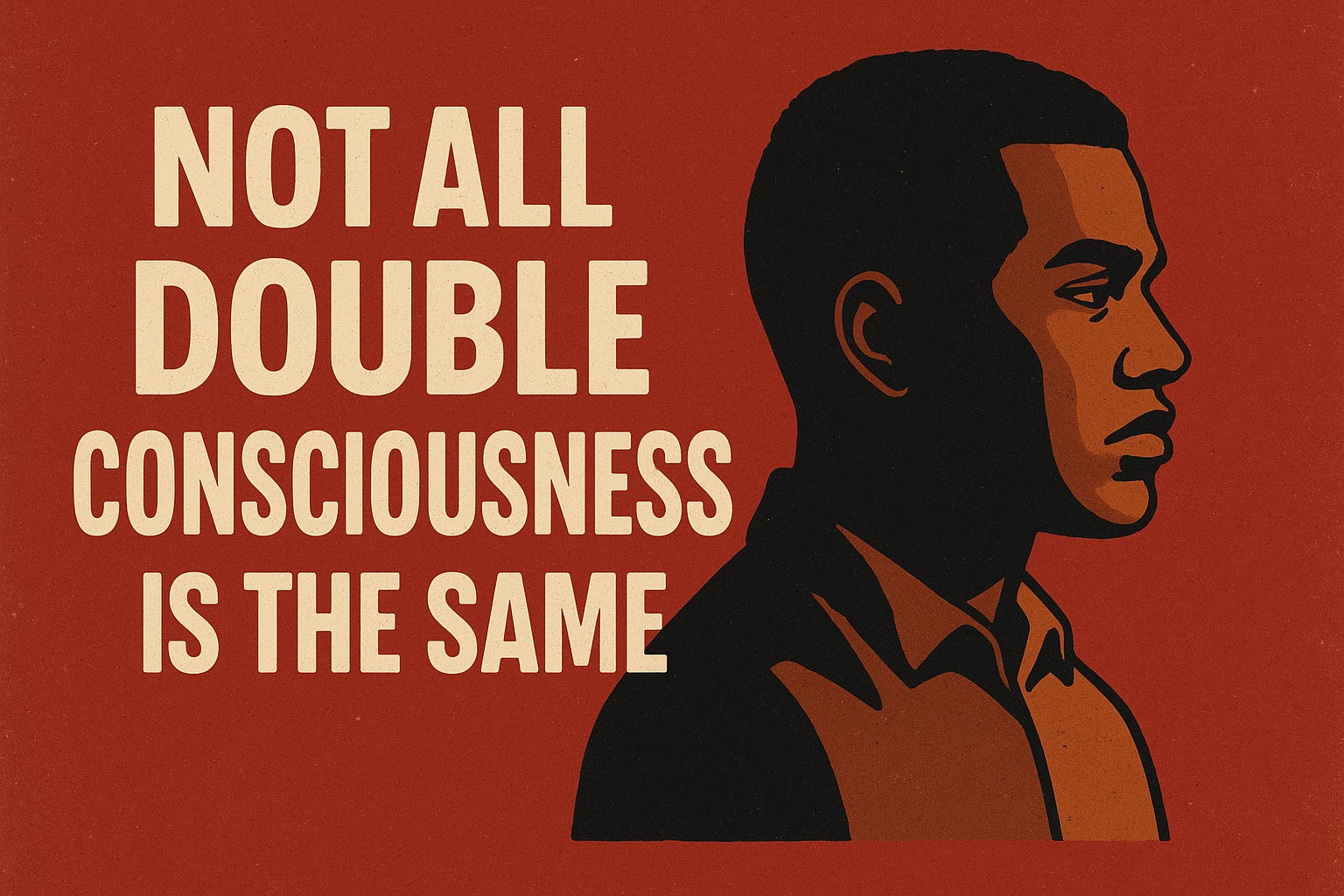
This essay reflects on Britishness from a diasporic perspective. It is grounded in the personal, historical, and sociological, but shaped above all by my observations growing up in southeast London, where I lived alongside diverse communities. My aim is to highlight how the struggles of belonging differ across groups — and why recognising these distinctions matters.
I was about six years old, in primary school, though I can’t recall the exact context. What I remember vividly was realising that my parents were Nigerians, but I was from Britain. How did that work, if I came from them? What was I? At the time I didn’t have the words for it, but I was already experiencing the beginnings of what W. E. B. Du Bois called double consciousness: the awareness of living between two identities, with both a sense of familiarity and friction towards Britishness.
In his 1903 book The Souls of Black Folk, Du Bois described double consciousness as the inner conflict of seeing oneself through two lenses: one’s own dignity and heritage, and the distorted view imposed by a prejudiced society. For Black Americans, it meant the constant tension of affirming who they were while navigating the expectations and hostility of the world around them. Since then, the idea has been used more broadly to describe the experiences of diasporic and minority groups worldwide.
I believe the concept applies in Britain, but not in the way it’s often assumed. Too often, we import American scripts into British debates about race and identity. In media and academia, Black British identity is treated as a monolith. Yet migration patterns reveal how varied the so-called “Black experience” really is.
The double consciousness of a British Nigerian is not the same as that of a British Somali. Both live with tension, but the histories, cultures, and moral frameworks that shape those tensions are not identical.
Nigerians and Somalis are among the largest Black diaspora groups in Britain, each comfortably numbering over 200,000 people when including their descendants. Yet in the British census both are collapsed into the single category of “Black African.” The result is that socioeconomic data and public analysis often treat them as one undifferentiated group and the consequences of flattening them together are significant.
Nigeria was once a British colony; its northern and southern protectorates amalgamated in 1914. Education, law, religion, and language were all embedded with British systems. As a multicultural state with more than 200 ethnic groups, Nigeria relied on English as a common medium of communication, both across regions and between communities. For this reason, many Nigerian families arrive in Britain with a postcolonial familiarity. Navigating institutions is not especially alien: there is already an understanding of how the laws of the land operate. In truth, interaction with Britishness did not begin when they first set foot in the country.
My own family illustrates this well. Three of my four great-grandparents were followers of English Protestant denominations — Anglican, Methodist, and Baptist. My parents were raised and educated in English-style Christian schools, where moral instruction and worship were central to formation. Among the Yoruba, Christianity and Islam have long coexisted within the same towns and villages, creating a pluralistic framework grounded in the sacred, rather than in the dominance of a single faith. In such an environment, tolerance emerges as a natural virtue. Generational stories also testify to the depth of British influence, from the use of the British West African pound to Nigerian figures who became recipients of British honours.
By contrast, Somalia’s colonial history was not primarily shaped by Britain, but by Italy, and its postcolonial period was marked by instability. Islam lies at the heart of Somali identity and ethics, and British secularism or Christianity can feel not only unfamiliar but even oppositional. This is not just a cultural gap, but a civilisational one. Somalis often arrive in Britain with a different moral and linguistic world, and many may feel more like outsiders than inheritors of a colonial relationship.
These histories shape migration pathways and adaptability within British society. Nigerians have often come as economic migrants, students, and professionals. Many grew up with stories of education as a path of elevation, a strong emphasis on being the best, and a working- or middle-class imagination of what the “good life” entails. Crucially, there is also a real belief that the system can work if one plays by its rules. This outlook naturally places Nigerians within British institutions — corporations, churches, school boards, and local governance — where they pick up British norms, habits, and ways of life.
Meanwhile, many Somalis arrived as refugees — traumatised, marginalised, and often resettled in deprived inner-city areas. Life is far harder to navigate under such conditions. By circumstance, they are frequently excluded from the professional and aspirational classes. The result is higher levels of institutional distrust and a deeper sense of communal marginalisation.
Such factors uniquely shape the cultural consciousness and self-perception of each diaspora group. For British Nigerians, the result is a postcolonial double consciousness. They are often fluent in the grammar of British institutions yet remain unsure of full acceptance. The conundrum is not whether they can feel at home among British people — becoming British is rarely the issue. The deeper question is, “Will I ever truly belong? Am I part of the national story, or am I still a guest because my ancestors are not from these isles?”
For British Somalis, the experience is closer to a triple alienation: “We are not white. We are not Christian. We are not from here.” Their struggle is not simply social, as it is often framed in media or academia, but also moral and political. For most, Islam is the strongest and most unifying marker of identity. Many live in tight-knit communities where the pressure to seek validation through Britishness is minimal. In fact, Britishness can feel synonymous with assimilation and cultural loss. The question of belonging in the nation’s story is less pressing — it is often not the question at all.
Policies and cultural narratives must take seriously the distinct stories of each diaspora. When everything is flattened into “Black,” we risk erasing deep historical, religious, and moral complexities. Human beings are not blank slates; we are inheritors of story and tradition. My own story does not begin in Britain, even though I was born and raised here. It begins with my parents, and with their parents before them. I have not only been formed by this inheritance — I am also its beneficiary. And while Britain has played a significant role in my personal story, I cannot ignore that the household in which I was raised laid the foundation of my thinking.
It is naïve to expect every diaspora group to integrate at the same pace. It is equally naïve to assume that material security and rights alone will make someone feel they belong. The spiritual yearning for belonging cannot be dismissed. For some communities, the distance between their daily lives and British society cannot be bridged simply by the passage of time. By the “third generation,” not everyone will automatically feel British. For that to be possible, the moral imagination for belonging must first exist within those communities themselves.
If we are serious about solidarity, it cannot be built on performative unity. It must begin with an honest reckoning with our differences. To be “Black” in Britain is not one story but many. We need better empathy, better language, and a wider imagination. The “model minority” label that often surfaces in debates about immigration and integration may sound flattering, but it rests on unfair comparisons. But at the end of the day, we are individuals. There are British Somalis — from Mo Farah to Chunkz — who have not only embraced a form of Britishness but have also navigated its institutions with success.
The truth is this: some of us are the children of empire. Others are the exiles of its collapse. Both carry scars — but they are not the same.
Great Post Jide! This is the kind of nuance missing in popular / common social media discourse on 'blackness'.
I too often find that outside of trivial or carnal considerations on what 'black' is, there's a dearth of perspectives on more important aspects of identity so this is refreshing.
Your artistry and surgical provision with your pen (keyboard) is beyond a worthy description .You stay light while going deep, You take your audience into the place where they / we /I look around 'see' hear grow new lenses And are forever changed. You say What's plain if only we are seeing looking hearing Your a beautiful genius masterfully
Your lived experience reflects and brings all that childhood young person and adult experience into sharp focus but gently skillfully