
Rooted Differently
Black British belonging and the making of a new inheritance

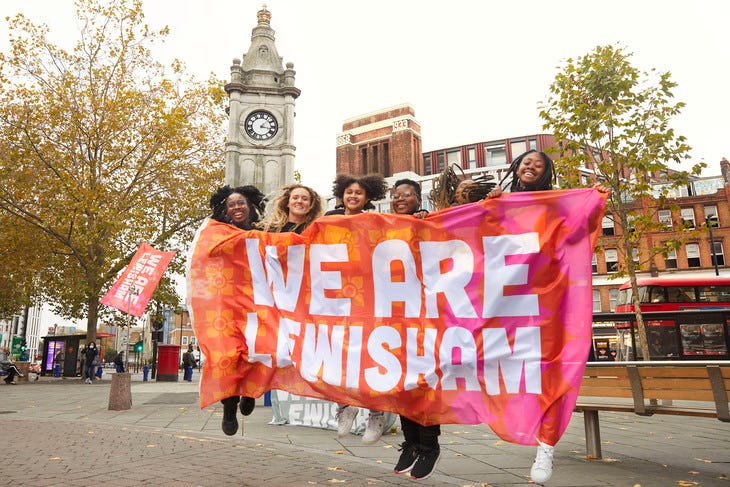
This essay builds on my Black Belonging series, exploring the place of Black Britons in modern Britain. It argues that identity and belonging are shaped less by abstract narratives and more by the lived realities of local life.
Many second- and third-generation ethnic minority Britons can relate to growing up with ancestral narratives, using their imagination to grasp what relationship, community, and belonging must feel like in the “motherland.” There is often a quiet envy that our parents were raised within extended family networks, coupled with an emotional distance from these stories, which rely heavily on imagination.
While Britain was “home,” it was also clear that the genealogical story of the country was not fully “ours.” Many of us did not have grandparents we could visit during school holidays. Our names, read aloud during the register, sounded distinctly foreign to these isles. Most visibly of all, our skin colour marked us out as an “ethnic minority.” There was no hostility or awkwardness, just a quiet awareness of being an “other.”
It was this dual relationship, between Britain, the country of my birth and social life, and Nigeria, the country that shaped my parents and ancestors, that led me to spend 13 months in Nigeria after university. It was a search to understand how Nigeria truly fit into my identity. I was certainly not the first, nor the last, to undertake such a journey, to ask: where do I truly belong?
My 13 months in Nigeria remain, to this day, the most formative period in shaping my understanding of social identity and belonging. It was there that I realised identity is shaped more by participation than by origin.
There was no denying that I was among people who “looked like me.” There was a sense of shared origin, and I recognised elements of the culture from my upbringing. Yet there was also a clear absence of shared cultural memory. Schooling, social codes, humour, and the rhythms of daily life were all markedly different. This went far beyond surface-level distinctions such as accent or dressing style.
There were few shared cultural touchstones from which relationships could naturally grow. The reality is that a Black Briton and someone born and raised in Lagos may share ancestry, but they are formed by fundamentally different moral imaginations. We may resemble our ancestry, but we are not shaped by it. This is not a rejection, only a recognition of reality.
Yet there is also an absence of deep British lineage. Britain’s rooted identities have been formed over centuries, with villages, counties, and surnames tied to land and history. For many Black Britons, that story is not yet theirs. There is affection for Britain, gratitude even, but also an awareness of not being historically rooted in the same way as their white British counterparts.
This is how the local becomes home and inheritance. Brixton, Lewisham, and Erdington are not just neighbourhoods, but social worlds. They carry shared struggles, memories, communal rhythms, and local heroes. The local and the lived become the new sites of belonging.
When Ian Wright (ex-England professional footballer) speaks about Brockley with such passion, he is not simply recalling the place he was raised, but a crucial part of his identity. It was there that he developed his love for football, where he pursued his dreams alongside his childhood friend David Rocastle, who would later become his teammate at Arsenal F.C., on the Honor Oak Park estate, and where his teacher, Mr Pidgen, mentored him. Brockley was not incidental to his life. It was formative. It shaped who he became and remains something he carries with him. It is a familiar sentiment for many second- and third-generation minorities.
They are not rootless, but rooted differently. I would argue that this marks the early stages of a new form of British inheritance. In generations to come, people will trace their belonging through boroughs and postcodes, just as others trace theirs through villages and counties. It is no coincidence that at my local church we have been discussing the absence of any real archive for the area, and how the church might become one, a place that holds the stories of the community for those yet to be born.
Place has always played a central role in formation. This is not theory, but a reality stretching back to time immemorial. From biblical times, themes of dwelling, land, and incarnation have carried meanings far beyond mere function. Communities were formed through shared time and presence, and these localities developed their own moral and social codes, shaping those raised within them.
There is a quiet dignity in these ordinary places that is often overlooked in contemporary discourse. We tend to view local investment through the lens of material improvement, measurable gains in quality of life. But what is often missed is that the renovation of a basketball court is not simply about keeping young people occupied. It becomes a site where new stories are formed.
Shared memories take root. Myths begin to emerge. These are not incidental, but essential to formation. They are the foundations of belonging and a reminder of the deeper significance of local investment.
It is also why the discourse around gentrification can feel deeply personal for many second- and third-generation minorities. From the outside, it may appear possessive or confrontational. But this is because socioeconomic change, even when beneficial in material terms, can feel like erasure. And when the local is the primary site of rootedness, that sense of loss becomes existential. Ironically, this is something those from Northern towns affected by deindustrialisation can also recognise.
Ancestry certainly matters, not just because it is an immutable truth, but because it tells a story. Not only as an origin myth, but a journey over time. Each of these stories has a place within the story of Britain.
Someone whose family has lived in Northumberland for centuries carries a deep local inheritance. But so too does a descendant of the Windrush generation, whose story reflects the history of Empire, Commonwealth, and its eventual settlement in places such as St Ann’s, Nottingham or New Cross, Southeast London. These, too, form part of the nation’s legacy.
Each story is different. Each carries its own weight. Yet all converge at the local, where life is actually lived. They are ultimately shaped by ongoing participation in the life of a place. Origin may provide the beginning, but identity and rootedness are forged through participation.
Black British belonging is not incomplete. It is in the process of becoming. This is a civilisational unfolding. We are in the “here, but not yet.” We can see the fragments of belonging and sense that we have not fully arrived.
But this is not a failure. It is the natural outworking of migration, social cohesion, and the ongoing negotiation of identity. Yet this is not a time for complacency. Cultural and economic anxiety is rising across the country, and questions such as “what does it mean to be British?” are moving to the centre of political life. A new chapter of British rootedness is quietly taking shape. It is important that these unfolding stories are not lost amidst the noise.
Loved this article Jide. Feel like I learned a lot from it.
Have you written elsewhere about your time in Nigeria?