

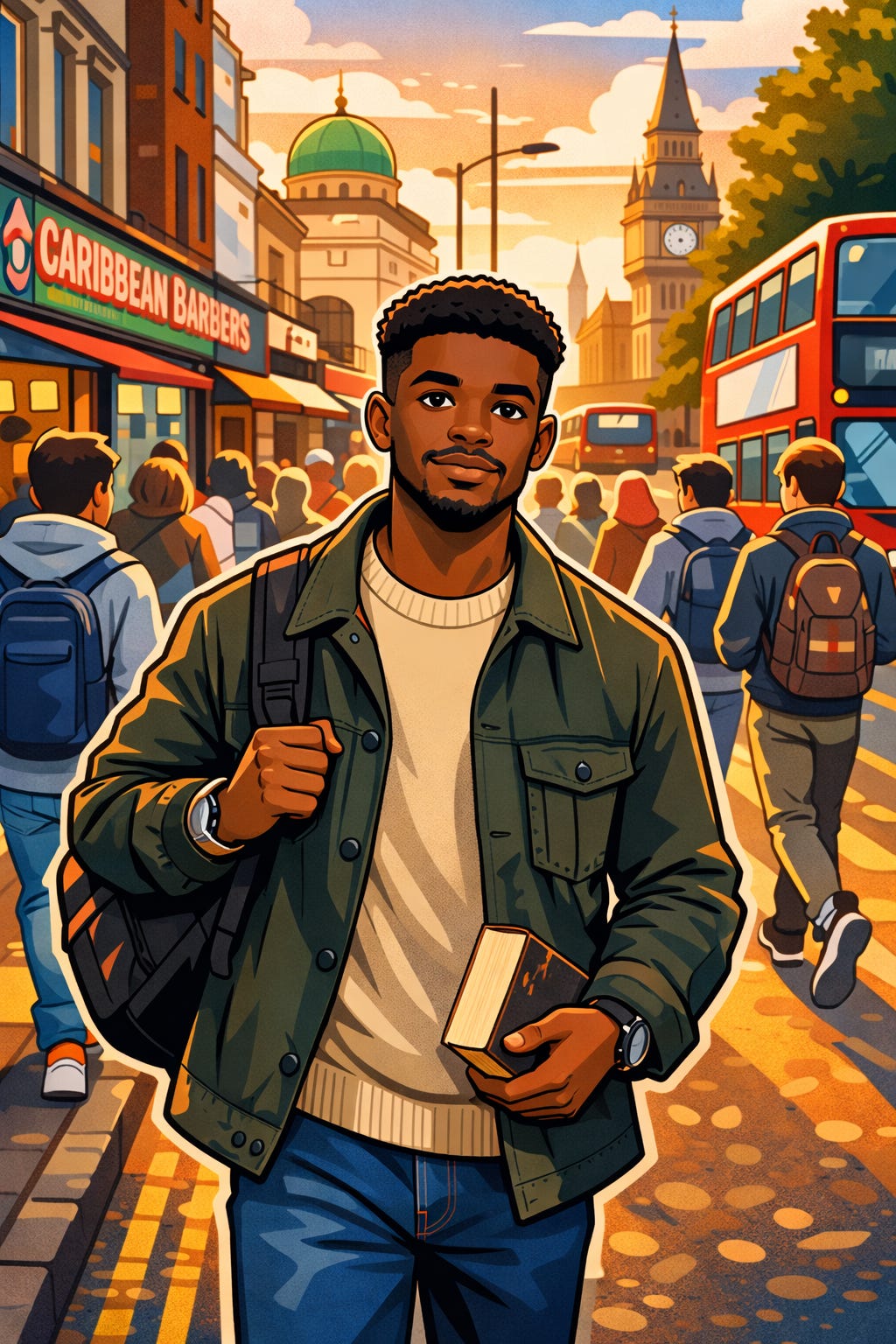
There was a moment last year that captured the sentiment behind this essay’s title. It was early June and I was walking down to my local barbers in New Cross, South East London. Dancehall music blasted in the background as I stepped inside, accompanied by a mixture of patois and Multicultural London English — conversations about football, work, and local life. To an outsider it might sound chaotic, but this was simply another day in this corner of Lewisham.
That same week, however, I was travelling to Oxford University to attend a conference on Christian Humanism. I remember returning home not only energised by the intellectual exchange, but struck by a deeper realisation: how many people are able to move between these worlds so seamlessly? One moment I am speaking MLE slang in a barbershop; the next I am writing about plausibility structures and my misgivings with procedural liberalism.
According to our inherited social categories, these two scenes are not meant to coexist. Yet here I am — living evidence that such a social reality does exist. That realisation led me to reflect more seriously on modern Britain and the new forms of social stratification now taking shape. I am not working-class in the old industrial sense, nor middle-class in the way the term is typically understood.
The classic British understanding of social class revolves around a working–middle class dichotomy, with further distinctions drawn between lower-middle and upper-middle strata. Class has traditionally been occupationally determined — blue-collar versus white-collar — and reinforced through accent, education, and taste. In Britain, class functions as far more than a proxy for income; it is a way of life, a cultural grammar through which people are read, sorted, and understood.
This dynamic runs through almost every sphere of British society. In politics, Labour emerged from working-class movements and trade unionism, while the Conservative Party has historically been aligned with elite institutions and the Anglican establishment. In sport, cricket has long appealed to middle-class sensibilities, while football became the cultural property of the industrial working class. Class, in other words, has shaped not only where people work, but how they speak, worship, vote, and play.
However, this inherited understanding of British society is becoming increasingly anachronistic. Modern Britain — like much of the global North — has been reshaped over the past half-century by exponential globalisation and the rise of techno-capitalism. We now inhabit a society defined by post-colonial immigration, deindustrialisation, and forms of work untethered from stable institutions or long-term occupational identity.
The result has been the emergence of new communities marked by hybrid cultural, religious, and linguistic norms. Traditional blue-collar markers have eroded, while new forms of economic precarity have taken their place, particularly within the gig economy. At the same time, the digital sphere has generated entirely new modes of labour — from blogging and freelancing to content creation and social media influence — each operating according to its own hierarchies of income, status, and cultural capital. These realities do not map neatly onto Britain’s old class categories, which assumed stable work, inherited cultural codes, and clear institutional pathways.
Today, social stratification is less a matter of inherited status and more a function of cultural fluency, networks, and civic participation. Many of the social worlds shaping contemporary Britain do not sit comfortably within the old class schema. Urban youth culture, for example, is often reflexively labelled “working class,” yet this designation obscures more than it reveals. Large numbers of second- and third-generation ethnic minority Britons are raised within these environments while later finding themselves operating within liberal professional culture — a milieu historically associated with the middle classes, but no longer dependent on its traditional markers.
At the same time, religious and community-based networks continue to function as significant forms of social capital, particularly within immigrant and diasporic communities. Recent electoral outcomes — such as the success of Gaza-focused independent MPs — illustrate how these networks can translate cultural cohesion into civic power. Alongside this, technical expertise has come to rival, and in many contexts supersede, the forms of cultural literacy once prized by the traditional middle classes. Institutional status is now more readily conferred through STEM credentials and specialist competence than through familiarity with the classics, theology, or inherited codes of taste.
My own life story illustrates these new social dynamics with unusual clarity. I was raised in a Nigerian Christian household that instilled a strong sense of moral formation and cultural discipline. At the same time, growing up in inner-city Lewisham immersed me in urban life, granting fluency in local idioms while also opening pathways into a wider, cosmopolitan imagination. My education further complicated this picture: private schooling provided a foundation in classical learning, literacy, and theological reflection, while higher education and professional training cultivated technical competence outside the language and sensibilities of liberal professional culture.
The result is a life lived across multiple social worlds, without being fully claimed by any single one of them. I move between these spaces with ease, yet never quite disappear into them. And in doing so, I often sense a quiet dissonance — an air of mystery — as though my presence unsettles the assumptions each world makes about who belongs where, and on what terms.
The defining question, then, is how these shifts challenge our assumptions about social mobility, politics, and civic engagement. The answers we give matter, because they shape the narratives and social frameworks embraced by policymakers, educators, and cultural commentators — and in turn, the moral imagination of the wider public. Understanding these emerging “civic classes” is therefore not an academic exercise, but a prerequisite for Britain’s renewal. They offer a more accurate lens through which to approach debates around inequality, integration, and social cohesion — issues that now sit at the very centre of our political and cultural life.
In a Britain that is increasingly diverse and pluralistic — shaped by the backdrop of techno-liberalism — the emergence of new identities, career pathways, and social sensibilities should not surprise us. This is, after all, the essence of culture: a constant negotiation of ideas, values, and lived experience. Social class has long been embedded in the fabric of British life, and to question its centrality will inevitably feel provocative.
Yet perhaps the provocation is now necessary. If our social reality has changed, then so too must the categories through which we understand one another. It may be time to stop measuring people by the old lines of class, and instead attend to the communities, skills, and cultural worlds they actually inhabit.
I think the same every time I go back home to Greece, especially when I am in my mother's village in Crete. It's like I belong to two different planets, not just countries/cultures/classes.