


A couple of weekends ago, Fraser Nelson wrote a column in The Times arguing that, broadly speaking, there has never been a better time to live in the UK. He has long pushed back against popular narratives like “Broken Britain” and “Londonistan,” which he sees as exaggerated. Some weeks earlier, he claimed that “London is a better city than it was a decade ago—or perhaps, at any time.”
While Nelson reasonably used statistics to argue that many complaints about the country’s decline are more subjective than objective, I think he missed a deeper point. Statistics, useful as they are, paint an abstract, often one-dimensional picture. The truth is, there are many Englands: Solihull is not Ely; Stockport is not Woking; Shrewsbury is not Harrogate. This diversity exists even within cities. Even London is often spoken of as a single place, as if it were a unified entity with a coherent character and shared destiny. Politicians, journalists, and even many of us fall into the habit of saying, “London is…”—followed by sweeping statements about its vibrancy, decline, wealth, crime rates, or cosmopolitanism.
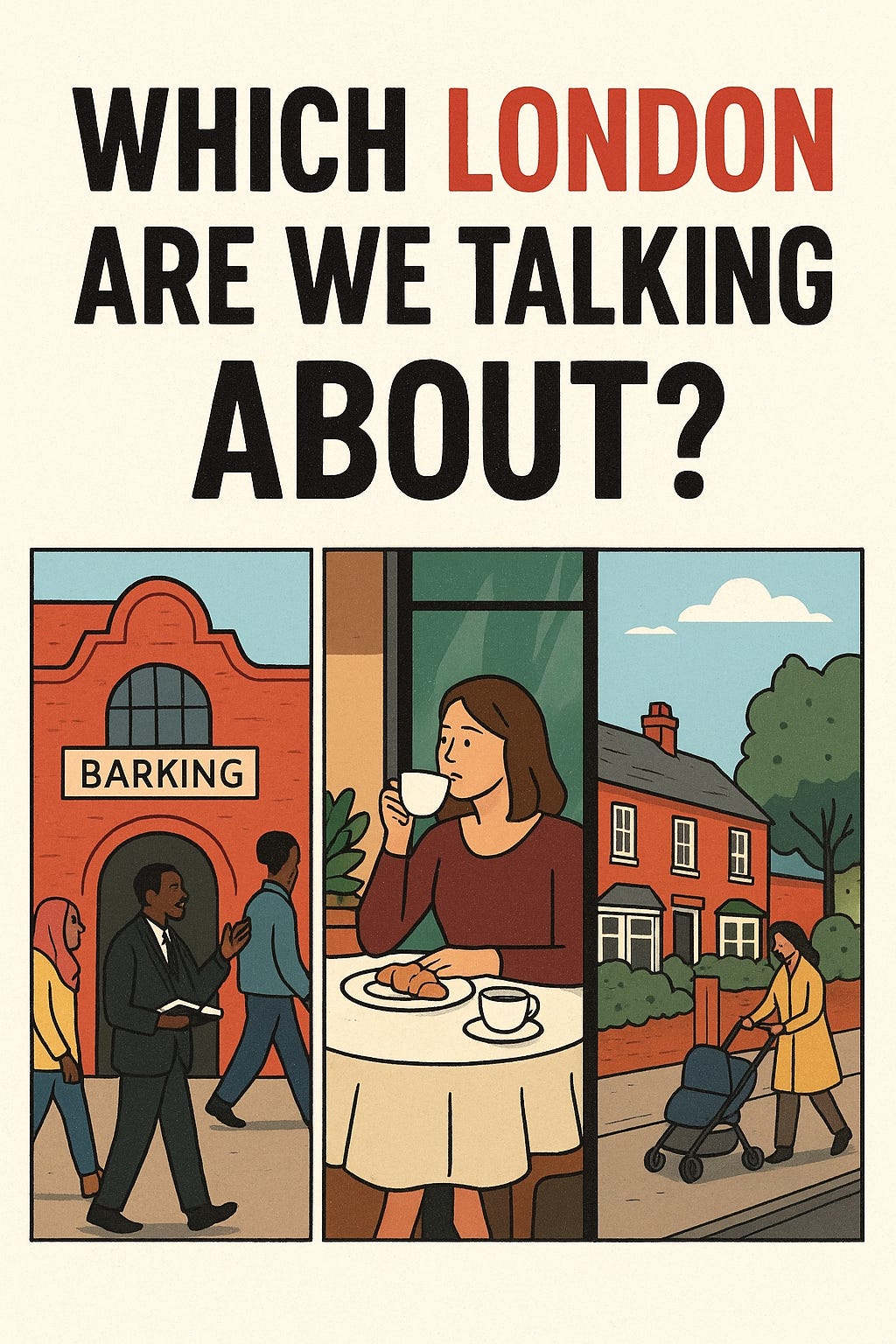
I remember stepping into Barking one midweek evening some years ago and seeing an African evangelical man preaching beside the railway station entrance. Hordes of people of different racial backgrounds were walking by, minding their own business. The scene felt chaotic—though perhaps it was simply the evening rush. Contrast this with an early afternoon brunch at a French café in Chelsea, where the atmosphere feels purposely contemplative, designed for calm reflection. Such contrasts exist across London.
Where I grew up—in the Ladywell–Brockley area of South London, known for its Victorian housing and green spaces—the stories and cultural inheritance differed greatly from neighbouring Turnham (the local name we use for the Honor Oak Estate and its surroundings). Turnham historically known more as the hotbed for gang activity. Our perception of the city is shaped by the narratives we inherit and the slices of the city we encounter, and these vary radically even within the same postcode.
Narrative inheritance is the cultural framework handed down before we even see the city for ourselves. It is built from the stories, expectations, and mental maps we receive from family, friends, culture, and media.
Someone who grew up in East London during the 2000s not only witnessed the rise of Grime music but also knows its predecessor, Jungle, which emerged from the UK rave scene. It blended breakbeats, reggae/dancehall basslines, and influences from sound system culture. To such a person, multicultural environments are hubs of creativity and innovation.
By contrast, someone whose parents lived in Kensington in the 1980s might perceive decline because their reference point was a wealthier, more homogeneous London—a London that felt ordered and less influenced by globalisation. International students often arrive in Britain expecting a “cinematic London”—Notting Hill, Sherlock Holmes, James Bond—formed through fictional depictions. Instead, they find a multicultural, high-rent city with overstretched public transport.
Alongside inherited stories, lived experience shapes our own personal London. My London is defined by a few square miles around Brockley, Ladywell, and Lewisham Central: green spaces, cafés, community events, football training, and the local church. These were key touchstones of my memories. The community is mixed—my Jamaican barber, the Indian family running the corner shop, the Turkish Cypriot dry cleaner. Everyone gets along. Increasing diversity has never been, for me, a marker of decline. A visible marker of decline would be decreasing social interactions that weaken community bonds.
For someone in Bethnal Green, “London” might mean tight-knit Bangladeshi communities, street markets, and rapid gentrification. For someone in Surbiton, it might mean suburban comfort and commuter rhythms. As humans, we tend to universalise our own slice of London as “the city.”
I find it helpful to think of Greater London in three broad categories—still generalisations, but closer to reality than treating it as one place:
Central London — the global brand: tourism, finance, government, culture. Expensive, crowded, heavily policed (West End, Westminster, Southbank, etc.). This is the London most outsiders imagine.
Inner London — densely populated, historically working-class, ethnically diverse, and sites of gentrification (zones 1 and 2). Often in the headlines for crime, poverty, and inequality. British drama Top Boy dramatizes parts of this life, but it is also the cradle of a global urban music scene—from So Solid Crew to Central Cee today.
Outer London — suburban, greener, quieter, with distinct political and cultural tones. A village atmosphere, a slower rhythm.
A Saturday in bustling Leicester Square (central London) is a different world from a coffee on Teddington High Street (outer London). A “crisis” in one London can be irrelevant in another. Current discourse often fixates on central London’s visible decline—pickpocketing, homelessness, dirtier streets—while Lewisham, where I live, has broadly stayed the same, and in some ways improved, at least aesthetically. Yet outer London sometimes loses its unique charm, with generic chicken and vape shops replacing independent stores. Public transport etiquette seems to degrade across the city as well.
We must understand that the refrain “London is getting worse” has context: rising house prices, visible homelessness, fare hikes, and knife crime are real. But we measure change against what we know, and the eras we feel nostalgic for—1960s Soho, 1990s Camden, the optimism of the 2012 Olympics—all colour perception. The problem is that these narratives are often shaped by selective experiences and media emphasis. In Brockley, I’ve seen more cafés, better public spaces, and more active community groups over the last decade due to middle-class families rooting themselves here. That doesn’t erase challenges like housing costs, but the quality of life feels different from the story told online. Too often, “London is getting worse” describes someone else’s London, yet it is treated as a universal truth.
Beyond anecdote, narrative inheritance also intersects with class, race, and migration. For example, a black person born in 1990s southeast London inherits stories from Windrush-era communities and the broader Black British experience—warnings about racist Millwall fans, avoiding Old Kent Road on Saturdays, alongside a belief that London offers opportunity and that the system works compared to that of the global south. Children of Eastern European migrants post-2004 inherit stories of opportunity tempered with tales of discrimination and community resilience. Second-generation Somali Londoners carry the memories of civil war from their parents and its impact on security and belonging. Even media-driven narratives—viral TikTok clips of “dangerous” streets, sensationalised news footage, Instagram portrayals of gentrification—inform perception, creating an impression of volatility that may not match lived experience elsewhere. These overlapping narratives create a city that exists simultaneously in multiple realities.
This matters. Treating London as a single entity risks flattening these differences in policy and public debate. Police allocations, transport planning, housing strategies, and investment often rely on aggregated statistics, masking distinct challenges in outer boroughs or the successes of inner suburban communities. Misunderstanding London’s internal diversity also distorts political discourse: crises in central London make headlines, but quieter triumphs elsewhere go unnoticed. Recognising multiple Londons encourages civic humility—an openness to perspectives beyond our postcode.
Ultimately, perception = inherited narrative + lived experience + geography. Accepting this makes public conversation about the city more honest. It reminds us that policy, media, and commentary must account for varied realities rather than universalising anecdote. London is many cities, many lives, many histories. Only by recognising these layers can we truly understand what it means to live here—and what the future might hold.
Very perceptive article, and it chimes with my experience as a Londoner of many years. We know our area, and we measure what people claim about London against our experience, over time. My area hasn't gentrified (except in the house prices!) and I see more obvious poverty and distress now than was here before the pandemic (homeless people outside the Coop begging, people obviously on drugs on the street). And yet, the community is still strong, there's a sense of purpose and plenty of entertainment to be had. I always feel happy returning to my streets. Good neighbours, good buses, never a dull moment!
In contrast, when I visit other towns and cities in England, including my childhood town, I am dismayed at the decline in the public space, the empty shops and obviously sick people (counting the mobility scooters and the overly thin/fat and prematurely aged men and women outside the pub). London has an energy and a "churn", new faces arriving, people trying out their little businesses. Much of England seems very depressed in comparison.
Hello! Thanks for this. It reminds me of a great essay from the early 90s by cultural geographer Doreen Massey, 'A Global Sense of Place', about how we might retain the notion of 'place' in a globalised setting while avoiding some of the reactionary associations of that word. Do you know it?